How day-old chicks should travel
Day-old chicks should travel in ventilated boxes divided into compartments, kept upright, out of direct sun, and never in a sealed vehicle. Compartments matter because loose birds slide into a corner and smother when a vehicle brakes or corners. Move them the shortest practical distance and get them under a warm brooder as soon as you arrive.
Peculiar Poultry · Updated 9 September 2026
Why compartments matter more than people expect
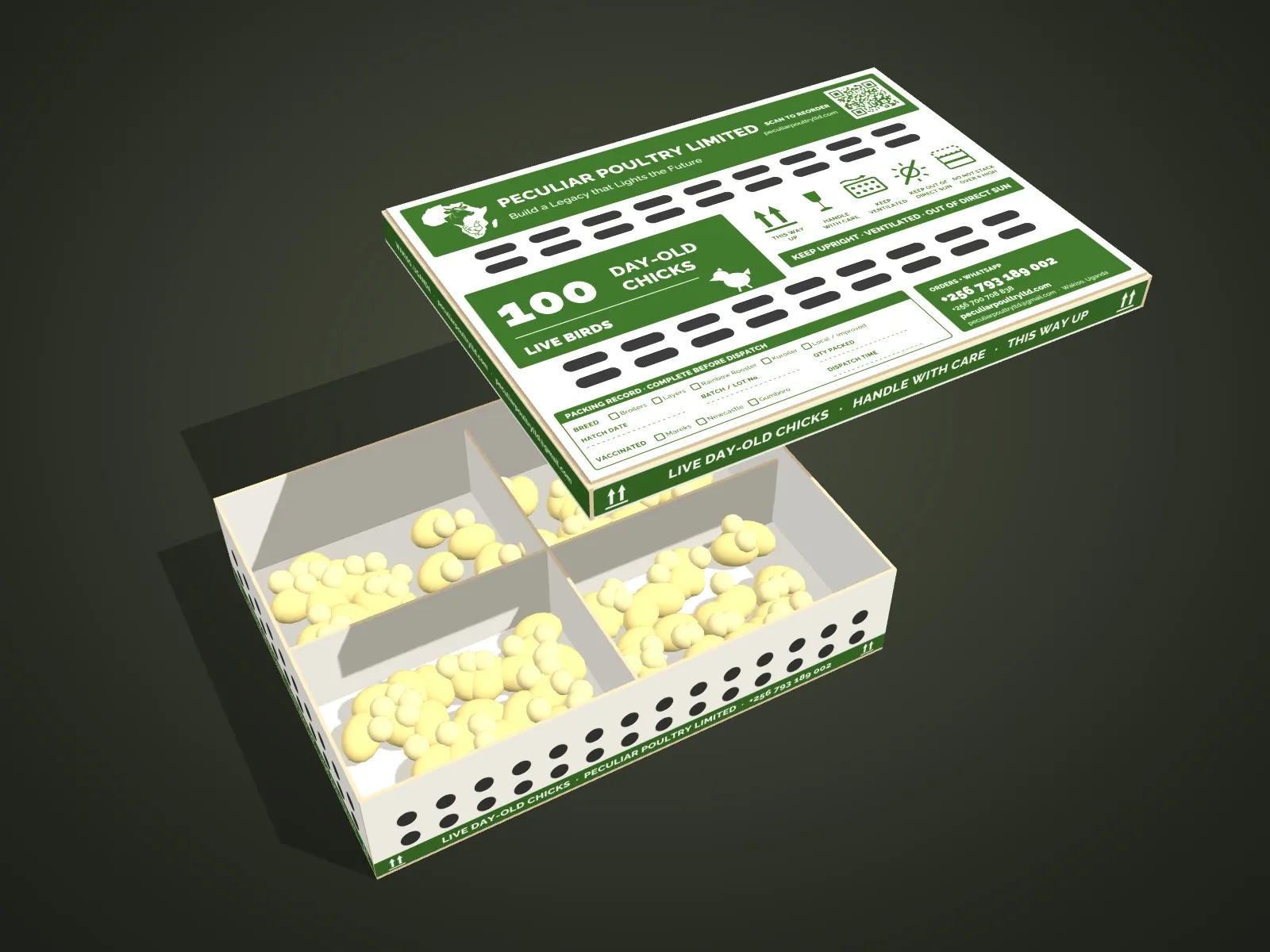
A hundred loose chicks in an open box behave like liquid. Every time the vehicle brakes, turns or goes over a bump, they slide to one end and stack up. Birds at the bottom of that pile suffocate, and the driver never knows it happened.
Dividing the box into four pens of twenty-five removes the run-up. Birds still move, but they cannot build a pile deep enough to smother the ones underneath.
Ventilation, and where the holes need to be
- Vents belong in the side walls, where they still work when boxes are stacked
- Holes must be small enough that a chick cannot push its head through
- Do not block the vents with luggage, sacks or another box pushed up against them
- A box that feels warm and stuffy from outside is already too warm inside
Heat is the thing that kills on a journey
A closed vehicle standing in the sun becomes an oven quickly, and chicks generate heat themselves. The dangerous moment is usually not the driving; it is the stop. A vehicle parked while somebody runs an errand is where batches are lost.
A short checklist for collection day
- 1
Have the brooder already running
Warm before you leave, so the birds go straight from box to heat when you get back.
- 2
Load boxes upright and level
Never on their side, never stacked so the bottom box is crushed or its vents blocked.
- 3
Keep them out of direct sun and off hot metal
A metal load bed in the afternoon radiates heat straight into the bottom of a box.
- 4
Drive straight there
Every stop is a risk. The journey should be the shortest part of the birds’ day.
- 5
Check and count on arrival
Count the birds, look for any that are cold, wet or unable to stand, and check the box details against your order before the boxes are thrown away.
Keep the box until the batch is settled
The breed, hatch date, batch number, quantity and vaccinations are written on the box. Copy them into your records before the box goes anywhere. If a problem shows up in week two, that is the information that makes it traceable.
Questions
How long can day-old chicks travel?
The shorter the better. Chicks live off the residual yolk sac for a limited period after hatching, so the journey should be planned around getting them warm, drinking and eating the same day rather than around what they can technically survive.
Can I carry chicks in a sack or a basin?
No. There is no ventilation, no protection from crushing and nothing to stop birds piling into a corner. Use a proper ventilated, divided chick box, which any serious supplier will provide.
Should the chick box be open or closed during transport?
Closed, but ventilated through the side walls. An open box lets birds escape and exposes them to draught and direct sun; a sealed one traps heat. The box is designed to do both jobs at once, so use it as designed.
What do I do as soon as I get home with the chicks?
Put them straight under the already-warm brooder, give clean water immediately, and watch until you have seen every part of the group drinking. Count them and record the box details while the birds settle.